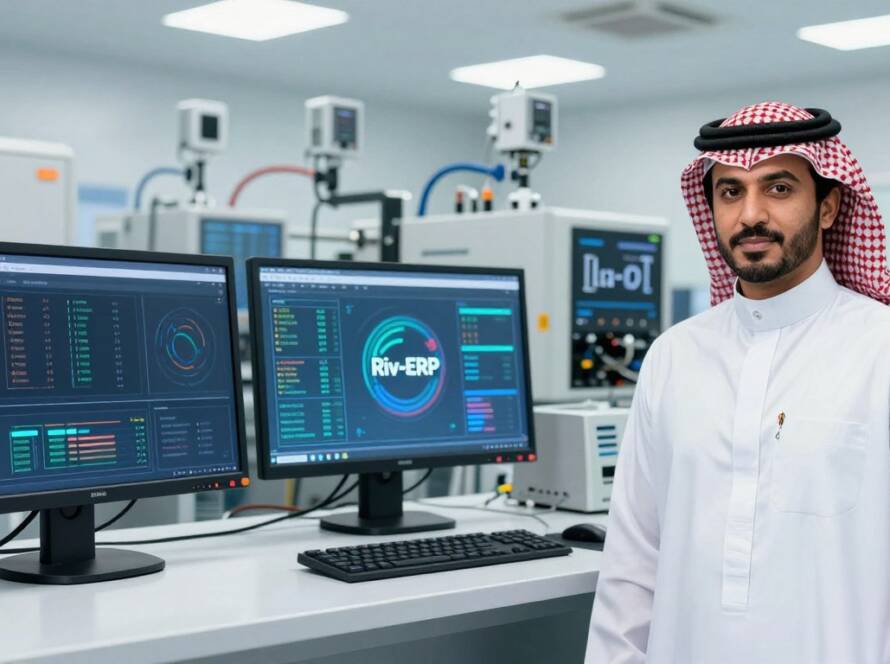
In many Saudi factories, the data exists but it is scattered: production figures in one system, inventory in an Excel sheet, and finance in a separate program. The result is decisions made on an incomplete picture, which is exactly the problem factory data unification solves.
This fragmentation affects daily work more than it seems. The finance manager may have to review records and reconcile figures manually before approving a report or making a decision on pricing and purchasing. The problem grows when each department uses different definitions for an item, a cost or a unit of measure, which limits the use of information and delays reaching a reliable result.
The phrase “What gets measured gets managed” is attributed to Peter Drucker, one of the leading thinkers of modern management. Whatever the differences in how it is sourced, it sums up the importance of turning data into measurable indicators, and then into actions that help management set priorities and measure their impact.
As the industrial sector expands in Saudi Arabia, the need to connect production with inventory and finance has become clearer. Companies need a unified source that improves data integrity, reduces duplication and supports planning instead of relying on scattered files. Data management is therefore no longer the responsibility of the IT department alone; it has become part of day-to-day business management.
This is where Enterprise Resource Planning (ERP) systems such as Riv-ERP can help, acting as a business management layer that connects data sources according to the system’s capabilities and configuration. The goal is not just to collect numbers, but to standardize their definitions and keep them updated to create clearer information, increasing the value of reports and helping managers rely on a trusted source when making decisions.
The following sections explain how unification starts with understanding data sources, then connecting production, inventory and finance, and measuring results in a practical way that benefits a factory owner who is not a technical specialist.
Key Takeaways
- Data scattered across different systems can lead to decisions based on incomplete or outdated information.
- Standardizing production, inventory and finance definitions helps create a more consistent operational and financial picture.
- Industrial expansion requires defining data sources and update responsibilities before choosing a technical solution.
- ERP systems help connect and analyze data, provided the configuration fits the factory’s needs.
- Faster decisions start from a reliable information source that can be reviewed and whose value can be measured continuously.
1. Why Scattered Data Costs You in Saudi Factories
Delayed data may seem like a minor problem, but it quickly turns into an operational and financial cost. When management waits for a report from production, then reviews it again with inventory and accounting, hours are lost that could have been used to improve operations and make more accurate decisions.
In some factories, data is spread across separate programs, Excel sheets and paper records. As a result, each department may show a different figure for the same item or the same unit cost. Collecting these numbers in one file is not enough; the factory needs data unification based on shared definitions, stored in the appropriate database, with a defined owner responsible for updating each record.
The Cost of Decisions Based on Incomplete Data
The production line records materials used, labor hours and energy consumption when a manufacturing order is executed. But this data may reach the finance department days later, after re-entry and reconciliation. In the meantime, purchasing may order additional raw material because the inventory balance is not up to date, or the sales team may set a price that does not reflect the actual unit cost.
The longer updates are delayed, the greater the likelihood of errors in pricing, budgeting and profitability assessment. Companies may also rely on old estimates instead of actual production data, widening the gap between what happens in the factory and what appears in reports. Factory data unification helps narrow this gap, provided clear procedures are applied to ensure data integrity and accuracy.
| Management decision | Without data unification | With factory data unification |
| Product pricing | Based on an old estimated cost, with recurring errors | Based on updated cost data after verifying the item definition and unit of measure |
| Monthly financial planning | Built on delayed manual reports and mismatched records | Built on data linked to production and inventory, according to the available update level |
| Profitability assessment | Appears after closing the accounts and reviewing variances | Appears faster when the database and procedures are integrated |
The Gap Between the Production Line and Finance
In many factories in Saudi Arabia, production and accounting operate as two separate islands. Each department has its own data, definitions and update cycle, and the finance team may not know when the quantity of a material or the cost of a production order has changed. This is where data management and identifying the source of each figure before it is approved become important.
This gap forces finance to prepare manually compiled reports, then search for the reason behind differences between the physical record and the booked record. Repeated transfers can cause further errors, especially when data is entered more than once or a different format is used for an item code.
Factories need a management layer that connects production with inventory and finance and shows the data path from recording a transaction to its appearance in a report. ERP systems such as Riv-ERP can help reduce manual work gradually, depending on the scope of integration and system configuration, without assuming human review is eliminated in all cases.
2. Data Sources in the Modern Factory
A modern factory produces varied data throughout the day, usually from three main sources: the production line and machines, inventory and warehouses, and finance. Identifying these sources and their responsibilities helps clarify what data unification means, moving from scattered numbers to information that can be compared and analyzed. The process starts by building a dictionary that defines the item code, unit of measure, production order number and cost center.
ERP systems such as Riv-ERP work as part of the business management layer that may connect these sources within a database or through integration between existing databases and systems. Connecting them does not mean all data automatically becomes correct; the factory needs clear rules for validation, permissions, record updates and review of results.
Production and Machine Data
Production data includes manufacturing orders, quantities produced, line speed, downtime, and material and energy consumption. MES systems or sensors may collect some of this data automatically, but whether it can be described as real-time depends on the type of equipment, the connection method and the update frequency.
If machine data stays in a separate system, it may not reach inventory or finance in time. The source of each piece of information should therefore be defined, and the production order number linked to the actual quantity and operating cost, while keeping a log that shows any change or re-entry.
Inventory and Warehouse Data
This data includes balances of raw materials, semi-finished and finished goods, and receipt, issue, transfer and stock-count movements. Every item needs a unified code and a fixed unit of measure; treating a material as a box in one system and a piece in another causes data duplication and makes comparison difficult.
Connecting the warehouse with the production line helps detect shortages before they disrupt operations and reduces unnecessary stockpiling. Factory data unification also increases the value of reports when inventory balances are up to date and auditable.
Financial and Accounting Data
Financial data includes invoices, expenses, journal entries, and material, labor and energy costs. Management uses this data to prepare reports, measure profitability and make decisions. In many Saudi factories, this information remains separate from production data, making it impossible to know the actual cost of a product or spare part.
Scattered data does not mean the information is missing; it means it is hard to reach and use at the right time and in the right form.
The following table shows the main differences between the three data sources in the modern factory:
| Data source | Responsible party | Data examples | Common tool |
| Production and machines | Operations department | Line speed, downtime, productivity rate | MES systems |
| Inventory and warehouses | Warehouse management | Material quantities, issue and receipt movements | WMS systems |
| Finance and accounting | Finance department | Invoices, costs, journal entries | Accounting software |
When these sources remain separate, no single database is enough to correct the different definitions. Standardizing criteria means departments agree on the format of the data, its source and who is responsible for updating it. Then the data becomes more consistent and turns into information that supports financial decisions.
3. Factory Data Unification: The Concept and Why It Matters for Today’s Industry
Some factory owners confuse collecting data with unifying it, although the difference is fundamental. Collecting moves files to one place, while unification deals with the meaning, format and rules that govern the data. Understanding this difference is the foundation of any successful information management project.
Factory data unification starts by setting shared definitions within the database: What is an item? What is the unit of measure? How is a production order linked to a cost center? And who has the authority to approve a change? These questions prevent building a database that looks organized but contains data that cannot be compared.
What Is the Difference Between Aggregating Data and Unifying It?
Aggregating data means copying numbers from multiple systems into a single report or file. Unifying it includes reviewing definitions, removing duplication, standardizing formats and linking records to a trusted source. If a raw material quantity appears in one database as 100 pieces and in another as 100 boxes, adding the two numbers will not produce an accurate report.
For example, if a spare part carries the same code in the maintenance and inventory systems, its use and cost can be tracked. If departments use different codes, finance will need to reconcile manually, and errors may appear in inventory or production cost.
Real unification means adopting shared rules that make data trustworthy and usable. These rules cover item naming, units of measure, update dates and approval responsibilities.
- Aggregating data: moving files to one place without standardizing criteria or verifying the source
- Unifying data: adopting shared rules that make data comparable and analyzable
- The practical difference: reports may look alike, but without real unification they mean different things
Why Is Unification a Competitive Necessity in Saudi Arabia?
Factories in Saudi Arabia need organized data to support efficiency, expansion and compliance. This does not mean unification is an independent official indicator for every authority, but it is a practice that helps management present performance more clearly when evaluating operations or seeking financing.
Data unification also improves data integrity, speeds up reporting and reduces contradictions between production, inventory and finance. Support bodies such as the Saudi Industrial Development Fund may evaluate a factory according to specific requirements and programs, so unification should not be treated as a guarantee of financing but as part of broader operational readiness.
Scattered data produces scattered decisions, while unified rules give management a clearer basis for comparison and planning.
In this sense, unification is not just a technology project but a way of organizing information and improving how it is used. The more a factory expands, the more urgent the need for a reliable database and shared business rules becomes.
4. Vertical and Horizontal Integration According to SIRI
The SIRI index provides a framework for assessing factories’ readiness and their ability to manage data and develop their digital operations. Its initiatives are linked to INCIT, an international body that develops methodologies for measuring smart factory maturity. The version and criteria adopted should therefore be verified before using SIRI to judge a factory or compare its results with others.
The framework focuses on two levels of integration that Saudi factories need: vertical integration across operational and management levels, and horizontal integration between departments and systems. Integration does not necessarily mean merging all programs into one; it may rely on APIs, middleware connectors or shared databases, depending on the current architecture and the factory’s needs.
Vertical Integration: From the Machine to Senior Management
Vertical integration, known as vertical integration ERP, describes how operational data moves from sensors, machines and the production line to monitoring systems and then to senior management. The value of this path appears when a machine stoppage reading is linked to the production order, the time it occurred and the relevant performance indicator.
A sensor may record a stoppage and send the event to the ERP system over an industrial network or an integration interface. But the automatic arrival of data does not mean it is ready to be relied on immediately; the connection must be tested, the reading’s quality verified, access permissions defined, and logs kept that show changes and the users responsible for them.
This integration gives management a view closer to real time, depending on the available update speed. It helps reduce reliance on delayed reports, but it does not remove the need for human review or clear rules for handling incomplete readings. Analytics or artificial intelligence tools can later be used to detect patterns, once the integrity of the core data is ensured.
Horizontal Integration: Data Flow Between Departments
Horizontal integration connects purchasing, inventory, production, finance and quality, so information moves according to shared rules instead of being re-entered in each department. When a material balance drops, the system can generate an alert or a purchase request according to approved permissions and procedures, not simply on the assumption that the process should happen automatically.
This mechanism helps reduce errors and data duplication, and gives teams a more consistent picture. Its success requires a unified data dictionary, defined record owners, controlled user permissions and an audit trail, followed by testing operating scenarios before expanding the rollout. In this way, data management becomes a shared responsibility of operations, finance and IT.
| Criterion | Vertical integration | Horizontal integration |
| Direction of data flow | From the machine to operations and management systems | Between different departments and systems |
| Main goal | A view of production performance closer to real time | Synchronized operations and unified data across departments |
| Direct impact | Faster analysis with controlled permissions and reviews | Fewer errors and less duplicate data entry |
| Practical example | Sending machine stoppage data to the ERP system via an integration interface | Linking inventory data with purchasing and finance |
For more details on the requirements of the SIRI standard and how to apply it in practice, see the smart factory readiness guide, which covers this topic in depth.
5. How Does an ERP System Actually Unify Factory Data?
An ERP system works as one of the business management solutions that organize the flow of data between the production line and the finance office. Data unification may rely on a central database or on structured connections between multiple systems, so a distinction must be made between integration that allows data exchange and database unification that enforces shared definitions and validation rules.
Connecting factory systems relies on a suitable database or connectors, linking production with accounting and inventory, and then automating the flow of information within the limits of the configuration. Before implementation, IT and operational teams need to test the interfaces, document the data dictionary and prepare a backup and recovery plan.
A Central Database Instead of Scattered Systems
Each department may keep its own program, but having a reliable database or integration layer helps prevent contradictions. This does not mean the system corrects every error automatically; input quality, approval rules and reviewing change logs are essential to the success of data unification.
Connecting Production Systems (MES) with Accounting and Inventory
MES systems can be a rich source of operational data, while accounting records costs and warehouses manage material balances. ERP connects these systems when suitable connectors are available, so production order data moves to financial and inventory records after verification, rather than simply assuming the update is instant in every environment.
| Criterion | Scattered systems | Unified ERP system |
|---|---|---|
| Data accuracy | Affected by differing definitions and re-entry | Improves with a unified dictionary and validation rules |
| Reporting speed | Requires manual reconciliation between systems | Improves according to the level of integration and updating |
| Cost of manual entry | High when records are entered repeatedly | Lower when automation and testing succeed |
| Decision speed | Delayed by unsynchronized reports | Faster when reliable, up-to-date data is available |
Automating Data Flow Between Departments
Automation is not limited to moving information; it includes defining the events that trigger an action, such as recording a receipt or closing a production order. This saves employees’ time and reduces repeated entry, while keeping review points that stop source errors from spreading to other systems.
Riv-ERP shows how this kind of need can be addressed in Saudi Arabia, according to the platform’s features and available integration capabilities. Support for MES, cloud systems and invoicing requirements should be verified before contracting, rather than assuming every factory environment is the same.
More details about this solution are available at riv-erp.com. For a deeper understanding of ERP applications in the industrial sector, see the article on ERP applications in manufacturing.
6. From Production Data to Financial Decisions: The Journey of a Number
The journey of a financial figure starts with the production order, not just the monthly report. When raw materials, labor hours, energy consumption and indirect operating costs are recorded, an initial picture of product cost takes shape. This data then moves through review stages into inventory and accounting records, becoming the basis for pricing and planning.
The result becomes more accurate when production and financial data are linked within one system or through reliable integration. If teams rely on re-entry or moving files manually, errors or differences may appear between the quantity produced and the recorded cost. Data unification is therefore not just about creating a shared report; it includes standardizing definitions, identifying data sources and reviewing every update before it is approved.
How Does Production Cost Become an Accurate Financial Figure?
The manufacturing process records materials consumed, worker wages, machine run time, energy and indirect manufacturing expenses. These costs are then charged to the production order or product according to an approved accounting policy. If a spare part is manufactured, for example, the material quantity, order number and operating hours should be linked in a single traceable record.
When this information moves into the accounting system after verification, the need to rewrite it decreases and the unit cost becomes clearer. Linking does not mean the figure is automatically correct; the quality of results depends on accurate inputs, allocation rules and reviewing exceptions. Database unification helps compare products and manufacturing orders against a consistent standard.
Linking the production line with accounting gives companies a better basis for pricing and profitability analysis. It may also help reduce stock-count variances, if receipt, issue and production movements are recorded in the same system and match actual procedures.
How Inventory Accuracy Affects Liquidity and Financial Planning
When the physical inventory balance matches the recorded balance, the finance manager can estimate purchasing needs and cash flow with greater confidence. An inaccurate balance may lead to overbuying that ties up cash, or a sudden shortage that halts operations and delays delivery.
Inventory accuracy should therefore be measured periodically, the movement of raw materials, products and spare parts verified, and any change in records documented. Describing the data as up to date is not enough; the time of the last update and who approved it must be defined, because real unification depends on ongoing procedures, not on a database alone.
When inventory accuracy meets clear production and financial data, financial decisions are based on information that can be reviewed. This is what our article on connecting production systems with accounting and inventory explains.
7. Hypothetical Case Study: Factory G for Equipment Before and After Unification
To understand the practical impact, we use a hypothetical example of Factory G for equipment; it is not a documented case study or a general result for all factories. The example reflects a common situation in organizations that rely on separate systems to manage production, inventory and accounting.
Before implementing a unified system, the factory recorded production in one program and inventory in a separate file, while finance relied on periodic reports. This led to differences in how some items were defined and delays in reconciling data, so preparing a report required extra time before a decision could be made.
Challenges Before Implementing a Unified ERP
Multiple Systems and Conflicting Figures
Each system kept its own version of the numbers, leading to duplicate data and difficulty knowing which record was most recent. The finance team also had to compare production orders with issue and sales movements, increasing the likelihood of errors during re-entry.
This conflict delayed report approval, and its impact could not be measured accurately without a clear baseline for the indicators.
Financial Reports Lagging Behind Production
Financial information arrived after the end of the production cycle, with a delay that varied depending on the volume of operations and the efficiency of review. Pricing and purchasing decisions might therefore be made on data that no longer reflected the actual balance or cost.
Results After Data Unification
In this example, item definitions were standardized and production orders linked to inventory and accounting, and the flow was tested before expansion. This reduced manual reconciliation and improved the clarity of reports, while the need to review exceptions remained.
Accurate Figures and Faster Decisions
Departments came to rely on a shared database, making it easier to track production cost and sales. “The same day” or “within hours” should not be considered a guaranteed result; speed depends on system configuration, data volume and approval procedures.
Fewer Variances Between Physical and Recorded Inventory
Integration helps detect variances early, but it does not eliminate stock counts or corrections. Before contracting with any ERP provider, it is advisable to review the terms and conditions for implementation and technical support, to make sure the service matches the factory’s needs.
| Indicator | Before unification | After unification |
|---|---|---|
| Inventory data accuracy | Recurring variances between physical and recorded stock | Measurable improvement after standardizing definitions and stock counts |
| Speed of financial reports | Delayed by manual reconciliation | Improves according to the level of integration and approval procedures |
| Production-finance alignment | Cost calculated manually and with a time lag | Updated through a structured flow after verification |
This hypothetical example shows that the value of a system does not depend on the technology investment alone, but on unifying data, controlling processes, defining responsibilities and measuring results before and after implementation.
8. Success Indicators for Measuring the Effectiveness of Data Unification
How does a factory manager know that a factory data unification project is delivering real value? It starts by setting a baseline before implementation, then defining indicators, owners, measurement frequency and reviewable targets. Buying a new system is not enough; the success of unification shows when data quality, speed of access and impact on decisions improve.
Indicators fall into operational and financial categories. The first measure the performance of daily operations and the quality of records, while the second show the impact of unified data on cost, liquidity and closing the books. The calculation method and source of each indicator should be documented so results do not differ between departments or change because different rules are used.
Operational Indicators
You can measure the time to prepare a production report, the inventory match rate, the number of re-entries and the error rate in production orders. You can also track the share of records with complete fields, exception handling time and how consistently teams follow data update procedures.
An improved indicator does not mean an immediate or fixed result in every factory. It is better to compare performance against the same baseline, then set a gradual target suited to the volume of operations and the number of systems. Clear data management and validation rules help improve data integrity and reduce differences between physical records and the system.
Financial Indicators
Financial indicators include the accuracy of actual production cost, the time to close the books, and the variance between estimated and actual product cost. They can also be linked to supply chain indicators such as demand forecast accuracy and inventory cost, to see whether data unification actually supports financial planning.
These measures help the finance manager assess the value of the system rather than just counting the reports it produces. Analytics or artificial intelligence can later be used to detect patterns and predict deviations, but this requires organized data and reliable rules first.
The following table gives indicative examples for comparison, not guaranteed results for every factory:
| Indicator | Before unification | After unification |
|---|---|---|
| Production report preparation time | Measured according to the current situation and baseline | Target reduction after integration testing |
| Inventory match accuracy | Determined through a documented stock-count sample | Improves with updated records and controlled rules |
| Monthly closing time | Affected by multiple systems and manual review | May fall after unifying data sources |
Saudi factories can draw on reference frameworks such as SIRI or materials published by INCIT when assessing digital maturity, while verifying the version and methodology. Results should also be linked to internal performance indicators; no standard should be treated as a substitute for measuring the operational reality.
Improvement in the indicators is linked to the level of vertical and horizontal integration, the quality of the systems, user training and the factory’s ability to scale the solution gradually. Regular measurement helps show whether data management solutions are having a real impact or need readjusting.
9. Digital Transformation and Vision 2030: An Umbrella for Unifying Factory Data
Factory data unification is part of the digital transformation path supported by Vision 2030 in Saudi Arabia. But it is not a separate requirement that guarantees competitiveness; it is a practice that helps factories organize their operations and improve their ability to read performance and expand.
Digital transformation is not limited to buying software; it includes redesigning procedures, defining responsibilities, securing data and linking production with finance. ERP systems can support this path when they match the factory’s needs and the requirements of the relevant authorities.
Unified data helps prepare clearer reports for regulators, but it does not prove compliance on its own. Official requirements should therefore be separated from operational benefits, and the current instructions of each authority verified before adopting any procedure.

ERP systems such as Riv-ERP form part of the business management layer that may help organize data, provided the system’s features and its integration with the factory environment are verified. Success starts with a clear goal, a measurable baseline and an implementation plan that progresses from pilot to expansion.
For a deeper understanding of the digital transformation path in the industrial sector, see the digital transformation guide. Ultimately, data unification remains a means of improving decisions and transparency, not a technical goal independent of the factory’s needs.
10. Alignment with Regulators in Saudi Arabia
Factory data unification may help prepare reports and invoices more consistently, but it does not guarantee compliance automatically. Compliance requires applying official requirements, verifying data accuracy and reviewing updates issued by the competent authorities.
When production, inventory and financial data are linked, there is less need to re-enter information in more than one system, and it becomes easier to review the source of a figure and its approval path.
E-Invoicing Requirements and Tax Compliance
E-invoicing requires correct data on the organization, items, quantities and taxes according to the regulations in force at the Zakat, Tax and Customs Authority. Internal integration helps prepare the invoice, but the integration must be tested and the technical requirements verified before going live.
Standards of the Ministry of Industry and Mineral Resources and the Industrial Development Fund
Unified reports may support a factory’s ability to present operational and readiness indicators on request. But the requirements of the Ministry of Industry and Mineral Resources or the programs of the Saudi Industrial Development Fund vary by program, and unification should not be presented as a guarantee of financing or eligibility.
| Regulator | Area of focus | Impact of data unification |
|---|---|---|
| Zakat, Tax and Customs Authority | E-invoicing and tax compliance | Helps prepare more consistent data |
| Ministry of Industry and Mineral Resources | Industrial operating standards | Helps prepare readiness reports |
| Saudi Industrial Development Fund | Support and financing for factories | May support demonstrating operational maturity according to program terms |
11. Smart Reports and Business Intelligence for Fast Decisions
After factory data is unified, the practical question remains: how does this data turn into a clear decision at the right time? This is where manufacturing business intelligence tools help, displaying production, cost and inventory indicators on dashboards a non-technical manager can understand.
Dashboards do not replace data management; they depend on it. If the database contains incomplete records or conflicting definitions, the dashboard may show a misleading result. The source of each piece of information, the time of its last update and who is responsible for reviewing it should therefore be defined before it is used in decision-making.
The finance manager can track production cost against budget, while the operations manager monitors downtime and completion rates. The supply chain manager can review inventory levels, turnover and spare parts needs. This tailoring reduces the time spent searching through reports, without assuming data becomes real-time simply because the system is installed.
Some business management solutions may use advanced analytics or artificial intelligence to detect patterns and forecast demand. But artificial intelligence does not automatically correct unorganized data, and AI recommendations need validation rules and human review. The value of AI increases when unified data and sufficient historical records are available, and AI results can be tested before being adopted in operations.
Key indicators shown on these dashboards include:
- Actual production cost versus budget, showing the data source and update date.
- Inventory level and turnover rate, supporting planning within the supply chain.
- Expected cash flow based on recorded orders and invoices.
- Downtime, production quality and adherence to the operating plan.
The purpose of smart reports is to simplify information, not make it more complex. Artificial intelligence can be used to help detect duplicate errors or unusual cases, but alerts must be verified before any change is made. In this way the dashboard becomes a working tool, not a substitute for management responsibility.
ERP systems such as Riv-ERP form part of the business management layer that may bring together data from production, inventory and accounting, depending on integration capabilities and configuration. Before adopting the solution, the database, permissions, audit trail and update flow between systems should be tested.
When reliable information is available, decision-making becomes faster and more measurable, and there is less need to rebuild reports manually. But the result depends on the quality of implementation, not on the name of the tool alone.
12. Common Challenges in Unifying Factory Data and How to Overcome Them
A factory data unification project faces challenges related to people, data and systems. Addressing them within a gradual plan helps reduce the risks of change and protect daily operations.
The plan starts by cleaning old data, identifying duplicate records and standardizing item codes and units of measure. IT teams then test integration between systems before training users on the new procedures. A pilot run follows, and the rollout is expanded after reviewing the results.
- Resistance to change: involve teams and explain the system’s impact on daily work.
- Migrating legacy data: clean and verify records before loading them into the new database.
- Uneven system readiness: test interfaces and fix errors before full integration.
A successful pilot does not mean the systems will run without review; clear update rules, an audit trail and local support help detect and correct errors early.

Involving teams from the start turns employees into partners in implementation. Saudi factories also need a fallback plan and ongoing support to reduce the impact of the transition on production. Successful change depends on measurable goals, not general promises.
Successful change is not imposed on the team; it is built with their participation from the start.
You can refer to the factory data unification case study or the role of smart reports to understand the implementation stages in practice.
13. How Does Riv-ERP Support Factory Data Unification?
Depending on its features and configuration, Riv-ERP can help factories connect production, inventory and accounting data in a single environment. The required integration should be verified before contracting, rather than assuming every factory needs the same path.
The potential benefit lies in fewer file transfers, better record tracking and reports that help management make decisions. Update time and cost accuracy depend on data quality, business rules and testing.
The practical step is therefore to book an assessment session via riv-erp.com and review data sources and required integrations before choosing the implementation scope.
14. Practical Steps to Start Unifying Data in Your Factory
Factory data unification starts with an actionable roadmap, not just buying a system. The following steps help you move from scattered data to an organized database, while protecting core operations and measuring results gradually.
Assess the Current State of Your Systems
Create a register showing the systems used in production, inventory and finance, the source of each piece of information and who updates it. Then identify points of data duplication, differences in item codes and units of measure, and gaps between reports. The assessment should include a dictionary describing the data format, the current databases, and permission and backup requirements.
The outputs of this stage include a list of systems, a data flow map and a baseline for indicators. Records that need cleaning before migration should also be identified, and the risks of data loss or errors during migration documented.
- The systems used in each department and the data source for each system.
- Gaps between production, inventory, finance and the supply chain.
- Duplicate records, missing fields, and approval and update rules.
This assessment gives management a practical picture before any technical decision and helps it define the project’s value and priorities.
Choose a Flexible ERP System That Can Integrate
After identifying the gaps, choose an ERP system that can integrate gradually with existing systems through suitable interfaces, without replacing everything at once. Review the system’s support for production, inventory and accounting, its scalability, user permissions, data integrity, and reporting and analytics.
Ask the solution provider about the migration plan, integration testing, support, upgrade costs and the possibility of using analytics or artificial intelligence later. A system should not be chosen for a single feature; successful business management solutions are those that fit the factory’s size, procedures and the teams’ ability to use them.
Train Teams and Manage Change
Train users on the new procedures, and make clear who approves data, who reviews it and who has authority to make corrections. Start with a limited pilot, then monitor the indicators and reduce the scope of risk before expanding. Involving employees and explaining the system’s impact on their work helps reduce resistance to change and improve data quality.
By following these stages, unification becomes a measurable project. AI tools remain useful for detecting patterns or errors once data is organized, but they are not a substitute for governance and audit rules.
15. Conclusion
A reliable financial decision starts with production data that can be traced and compared. Factory data unification helps link production with inventory and accounting, reduce re-entry and improve the clarity of reports, without assuming the system eliminates human review or closes every gap automatically.
Saudi factories need to review their current systems, clean their records, choose a system that can integrate, then train teams and measure results. In this way data becomes a tool for improving operations and decision-making, not just more files.
This path is consistent with digital transformation and the goals of Vision 2030, but it requires a plan suited to each factory’s needs. Artificial intelligence and advanced analytics can be used later, after building a reliable database and clear data management rules.
The first step is to prepare a register of systems and information sources and identify the gaps. After that, you can request an assessment session or a demo from a suitable provider and compare solutions on integration, support, cost and scalability.
─────────────────────────────
Is your data scattered across separate systems?
Riv-ERP unifies it on a single platform.
Contact us at riv-erp.com
─────────────────────────────
FAQ
What exactly does factory data integration mean?
What is the difference between vertical integration ERP and horizontal integration?
How are production and financial data linked in practice within an ERP system?
How can different factory systems be connected without replacing everything at once?
What is the role of manufacturing business intelligence in this context?
Is data unification only suitable for large factories?
How long does it take to implement a unified system for factory data integration?
How does Riv-ERP help with this transformation?
See Riv-ERP in action
Two editions: RivDesktop on your own server, or Riv-ERP Cloud on Oracle Cloud.
Book a demo